


RESEARCH
Infant Mental Health Home Visiting
(IMH-HV)
What is Infant Mental Health Home Visiting?
The Michigan Model of Infant Mental Health Home Visiting (IMH-HV) is a needs-driven, relationship-focused intervention for parents and infants/toddlers aged 0 (pregnancy) to 36 months. IMH-HV aims to meet the needs of families at risk for relationship problems, child abuse and/or neglect and behavioral health concerns. Families are eligible for IMH-HV if either the parent or child have concerns that make them more susceptible to disruptions in the parent-child relationship (e.g., parent mental health, child social-emotional and regulatory concerns).
IMH-HV is delivered weekly in families’ homes by Master’s-level providers. Through a multifaceted approach, IMH-HV aims to strengthen parental competencies, promote mental health and sensitive caregiving, and thus reduce risk for the infant/toddler and lessen the probability of intergenerational transmission of the effects of unresolved loss and trauma in parents.
IMH-HV is currently provided through the Michigan Department of Health and Human Services to Medicaid-eligible, pregnant women and families with infants and young children.
For more information on the Michigan Model of IMH-HV, visit the California Evidenced-based Clearinghouse website that contains an Indepth explanation the program's goals, logic model, implementation, and more.
Training
Information
Providers can be trained in the Michigan Model of Infant Mental Health Home visiting by contacting one of the following organizations:
Our Work
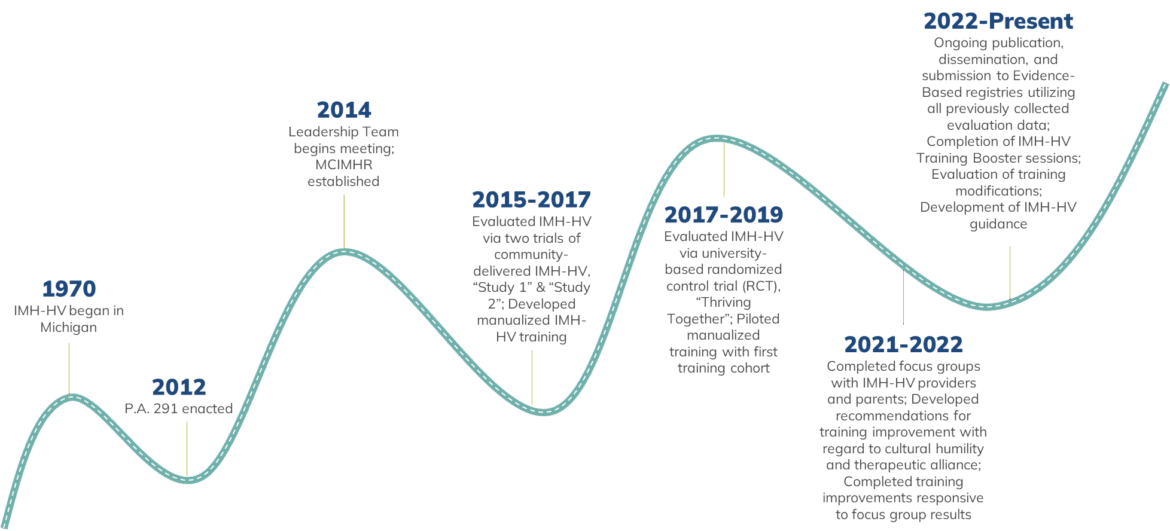
Michigan is widely recognized as the “birthplace” of infant mental health practice. While IMH-HV has been implemented and delivered to families eligible for Medicaid through the public mental health system in Michigan for 50 years, it previously lacked efficacy data to meet specified state and federal standards, thus risking the sustainability of the treatment model and its ongoing funding. The Michigan Department of Human Health and Services (MDHHS) approached the Zero to Thrive (Z2T) faculty at the University of Michigan (UM) to pursue rigorous evaluation of IMH-HV program effectiveness.
Principal Investigators Dr. Katherine Rosenblum and Dr. Maria Muzik, coalesced a leadership team comprised of policy and infant mental health advocacy organizations and a research team comprised of prominent infant and early childhood researchers across 8 regional universities, who collectively designed, implemented and analyzed data from two quasi-experimental studies completed in the community and one university-based randomized control trial. Data and subsequent publications from these evaluations provided the basis for IMH-HV’s 2021 CEBC submission and eventual rating. MDHHS, Z2T, and the Alliance for the Advancement of Infant Mental Health will collaborate in ongoing efforts to disseminate the model.
Timeline
Partners
Leadership Team
Betty Tableman
Michigan Association for Infant Mental Health
Mary Ludtke
Michigan Department of Health and Human Services
Katherine Rosenblum
Zero to Thrive, Michigan Medicine
Maria Muzik
Zero to Thrive, Michigan Medicine
Jessica Riggs
Zero to Thrive, Michigan Medicine
Deborah Weatherston
Alliance for the Advancement of Infant Mental Health
Nichole Paradis
Alliance for the Advancement of Infant Mental Health
Amy Zaagman
Michigan Council for Maternal and Child Health
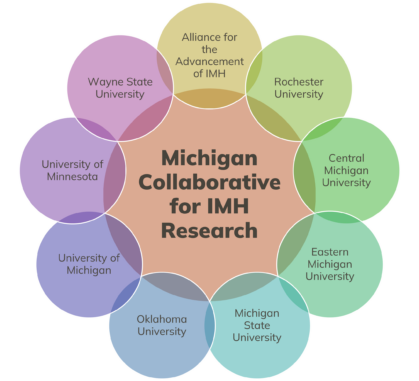
Michigan Collaborative for Infant Mental Health Research (MCIMHR)
The Michigan Collaborative for Infant Mental Health Research (MCIMHR) is composed of researchers from eight universities and from the Alliance for the Advancement of Infant Mental Health, whose efforts are aligned with the promotion of research of Infant Mental Health. Core MCIMHR members have collaborated in the design, implementation and/or dissemination of the current study. MCIMHR core members include (in alphabetical order): Emily Alfafara, Carla Barron, Holly E. Brophy-Herb, Nora L. Erickson, Hiram E. Fitzgerald, Alissa C. Huth-Bocks, Meriam Issa, Jennifer M. Jester, Megan M. Julian, Jamie M. Lawler, Rena Menke, Alyssa S. Meuwissen, Alison L. Miller, Maria Muzik, Larissa N. Niec, Jerrica Pitzen, Julie Ribaudo, Jessica Riggs, Katherine L. Rosenblum, Sarah E. Shea, Paul Spicer, Ann M. Stacks, Chioma Torres, Laurie Van Egeren, Christopher L. Watson, Rachel Waddell, Deborah J. Weatherston and Kristyn Wong.
Community Partners
IMH-HV evaluations and training development was completed through collaborations with 19 community mental health service provider agencies from 12 counties across Michigan.
Wayne
Detroit Wayne Integrated Health Network
Hegira Programs, Inc.
Development Centers
Starfish Family Services
The Guidance Center
The Children’s Center
Southwest Solutions
Arab-American Chaldean Council
Genesee
Genesee Health System
Genesee County Easter Seals
Jackson & Hillsdale
Highfields, Inc.
Integro, LLC
Kalamazoo
Community Healing Centers
Kent
Arbor Circle
Midland
Central Michigan CMH
Muskegon
Healthwest
Oakland
Oakland County Easter Seals
Ottawa
Ottawa County CMH
St. Clair
St. Clair CMH
St. Joseph
CMH of St. Joseph County
What We’ve Learned About the Michigan Model of Infant Mental Health–Home Visiting ➔
A summary of research findings from more than 20 published studies
Featured Publications
Research Updates - View the most recent findings from our work HERE.
Pitzen J, Rice D, Durán B, Jester J, Riggs J, Julian M, Appold B, Muzik M, Rosenblum K and Michigan Collaborative for Infant Mental Health (2025) The Michigan Model of Infant Mental Health Home Visiting increases preventative services while decreasing emergency services for children. Front. Psychol. 16:1549246. doi: 10.3389/fpsyg.2025.1549246
Petroff, R. L., Jester, J., Riggs, J., Alfafara, E., Springer, K., Kerr, N., Issa, M., Hall, A., Rosenblum, K., Goodrich, J. M., Muzik, M., & Michigan Collaborative for Infant Mental Health Research (2024). Longitudinal DNA methylation in parent-infant pairs impacted by intergenerational social adversity: An RCT of the Michigan Model of Infant Mental Health Home Visiting. Brain and behavior, 14(9), e70035. https://doi.org/10.1002/brb3.70035
Jester, J. M., Bengel, C., Issa, M., Duprey, M., Riggs, J. L., Hoffman, C. M., Harris, S. D., Muzik, M., & Rosenblum, K. L. (2024). Infant mental health integration into OB care leads to increased connection to services during the perinatal period. Infant Mental Health Journal, 1–17. https://doi.org/10.1002/imhj.22152
Julian, M. M., Riggs, J., Wong, K., Lawler, J. M., Brophy-Herb, H. E., Ribaudo, J., Stacks, A., Jester, J. M., Pitzen, J., Rosenblum, K. L., Muzik, M., & Michigan Collaborative for Infant Mental Health Research (MCIMHR) (2023). Relationships reduce risks for child maltreatment: Results of an experimental trial of Infant Mental Health Home Visiting. Frontiers in psychiatry, 14, 979740. https://doi.org/10.3389/fpsyt.2023.979740
Rosenblum, K. L., Riggs, J., Freeman, S., Shah, P. E., Muzik, M., & Michigan Collaborative for Infant Mental Health Research (2022). In-the-moment ratings on the Early Relational Health Screen: A pilot study of application in home visiting and primary care. Infant mental health journal, 43(3), 410–423. https://doi.org/10.1002/imhj.21978
Stacks, A. M., Jester, J. M., Wong, K., Huth-Bocks, A., Brophy-Herb, H., Lawler, J., Riggs, J., Ribaudo, J., Muzik, M., & Rosenblum, K. L. (2022). Infant mental
health home visiting: intervention dosage and therapist experience interact to support improvements in maternal reflective functioning. Attachment & human development, 24(1), 53–75. https://doi.org/10.1080/14616734.2020.1865606
Riggs, J. L., Rosenblum, K. L., Muzik, M., Jester, J., Freeman, S., Huth-Bocks, A., Waddell, R., Alfafara, E., Miller, A., Lawler, J., Erickson, N., Weatherston, D., Shah, P., Brophy-Herb, H., & Michigan Collaborative for Infant Mental Health Research (2022). Infant Mental Health Home Visiting Mitigates Impact of Maternal Adverse Childhood Experiences on Toddler Language Competence: A Randomized Controlled Trial. Journal of developmental and behavioral pediatrics : JDBP, 43(4), e227–e236. https://doi.org/10.1097/DBP.0000000000001020
Download our annotated bibliography HERE.
Funding Acknowledgment
Various IMH-HV projects supported by funds from the Center of Medicare and Medicaid Services through the Michigan Department of Health and Human Services (MDHHS); the MDHHS Children’s Mental Health Block Grant; the Ethel and James Flinn Foundation; the Gerstacker Foundation; the Michigan Health Endowment Fund; and the University of Michigan Department of Psychiatry’s Women and Infants Mental Health Program.
Zero to Thrive
4250 Plymouth Road
Ann Arbor, Michigan
© 2026 Regents of the University of Michigan. View our privacy policy here.